
 ES
ES EN
EN RU
RU SA
SAA Freightliner Cascadia brake chamber converts compressed air pressure into the mechanical force that pushes the brake shoes against the drum or the pads against the disc rotor. On a standard Cascadia, the drive axles use double-diaphragm spring brake chambers, usually marked 30/30, while the steer axle uses a smaller service chamber such as Type 16 or Type 20. When you replace one, match the type number, stroke, mounting pattern, and port orientation of the original unit, and never substitute a plain service chamber on a drive axle, because that removes the parking brake function.
Content
- 1 Which Brake Chamber Does a Freightliner Cascadia Use?
- 2 How to Identify the Right Cascadia Brake Chamber
- 3 Symptoms of a Failing Brake Chamber
- 4 The 2020 Cascadia Brake Chamber Recall
- 5 Replacing a Cascadia Brake Chamber: Key Steps
- 6 Buying a Replacement: Quality and Fit Considerations
- 7 Maintenance and Inspection Tips
- 8 Frequently Asked Questions
Which Brake Chamber Does a Freightliner Cascadia Use?
A Cascadia does not use the same chamber at every wheel position. The configuration depends on the axle position, brake style, suspension, and fleet specification. In most over-the-road Cascadias, the layout looks like this:
| Axle position | Chamber type | Common size | Function |
|---|---|---|---|
| Steer axle | Service brake chamber | Type 16 (T16) or Type 20 (T20) | Front-wheel service braking |
| Drive axles | Spring brake chamber, double diaphragm | 30/30 | Service, parking, and emergency braking |
| Tag or pusher axle | Service or spring brake chamber | Type 20, Type 24, or Type 30 | Depends on lift-axle specification |
| Trailer, if applicable | Spring brake chamber | 30/30, 24/24, or 16/16 | Service and trailer parking braking |
The type number refers to the effective diaphragm area in square inches, so a Type 30 chamber produces roughly twice the push force of a Type 15 at the same air pressure. Freightliner specifies these sizes to keep front and rear brake force balanced under full application.
How to Identify the Right Cascadia Brake Chamber
The fastest way to identify the correct replacement is to read the data tag or stamped marking on the old chamber. Service chambers are marked with a number such as "T20" or "Type 30," and spring brake chambers carry two numbers such as "30/30," where the first number is the service diaphragm and the second is the spring side. Before ordering, confirm these five points:
- Type and stroke: T16, T20, T24, or T30, and standard stroke (about 2.5 inches) versus long stroke (3.0 inches).
- Mounting pattern: two-stud, four-stud, or clamp-type housing, plus the distance between mounting holes.
- Port size and position: normally 3/8-inch or 1/2-inch NPT, pointed so air lines stay clear of suspension parts.
- Brake style: drum versus air disc, which use different brackets and push rod lengths.
- Air inside versus air outside: some Cascadia disc configurations route air through the chamber differently.
If the old chamber has no readable markings, measure housing diameter, push rod stroke, and clevis size, and compare with a dimension chart. A VIN-based dealer lookup is safer than measuring when the part number is not visible.
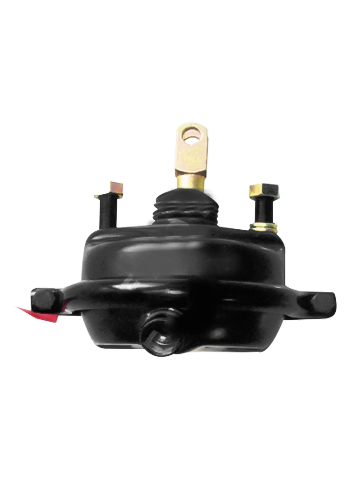 Truck Disc Spring Brake Chambers for Commercial VehiclesThis selection of truck disc spring brake chambers includes common models like T30, T24, and T16, making it useful when you need to match an unmarked old unit by dimension or a VIN-based lookup.View Product →
Symptoms of a Failing Brake Chamber
A failing brake chamber rarely stops working without warning. It usually gives one or more of these signs first:
- Hissing air around the chamber or at the service port when the brakes are applied
- Parking brake that will not release, or releases slowly
- Weak braking or longer pedal travel
- The truck pulls to one side during braking
- A hot wheel end and the smell of burning lining
- Visible cracks in the housing, a bent push rod, or a rusted clamp
Any of these symptoms is a reason to inspect before the next trip. In the worst case, a chamber can detach if the clamp fails or the bracket breaks, leaving that wheel with no braking force.
The 2020 Cascadia Brake Chamber Recall
Some 2020 Cascadias were recalled under NHTSA campaign 19V803 because of inadequate clearance between the brake chambers and the frame rail, particularly on air disc brake configurations. On affected trucks, the chamber could contact the frame rail during suspension movement, and in some cases it could detach, causing a loss of braking at that wheel and an increased risk of crash.
If you are working on a 2020 Cascadia, verify whether the VIN is included in the recall before buying a replacement chamber. Dealer inspection and remedy are free. Even outside the recall population, check the clearance between the chamber and frame after suspension work, because a shifted axle, worn mounts, or replaced springs can recreate the same contact condition.
Replacing a Cascadia Brake Chamber: Key Steps
Replacing a chamber is straightforward if you have basic air brake tools, but the spring inside a spring brake chamber stores enough energy to injure anyone who opens it without caging. Always cage the spring before loosening anything. Follow this sequence:
- Park on level ground, chock the wheels, and drain all air pressure from the tanks.
- Cage the spring brake by removing the dust plug, threading the caging bolt into the release stud, and tightening until the spring is fully compressed.
- Remove the air lines and cap them immediately to keep out dirt.
- Unbolt the chamber from the slack adjuster and bracket.
- Install the new chamber with the ports in the correct orientation and torque the fasteners to specification.
- Reconnect the air lines, pressurize the system, and check for leaks with soapy water.
- Apply and release the brakes several times, confirm push rod stroke, and only then uncage the spring.
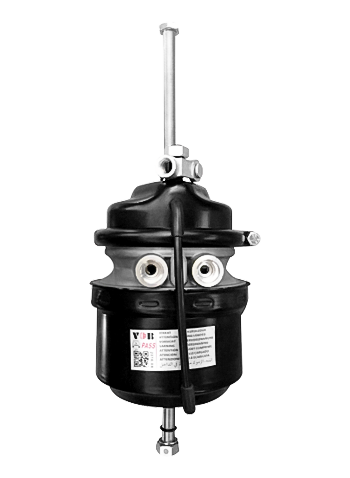 T16/24DP Air Outside Brake Chamber for Service ReplacementsThis air outside brake chamber fits applications requiring the T16/24DP type. Because its internal spring stores strong energy, cage the spring before disassembly during replacement.View Product →
If the brake shoes or pads are badly worn, a new chamber will simply mask the real problem. Check lining thickness and slack adjuster operation at the same time.
Buying a Replacement: Quality and Fit Considerations
The cheapest chamber on the shelf is generally the most expensive one in the long run, because a roadside failure costs more than the part itself and the labor to replace it again is far greater than the price difference. Cascadia owner forums include reports of premature failures with low-cost chambers that were never leak-tested, had poor welds on mounting studs, or lost the diaphragm seal within the first winter. That does not mean every affordable chamber is bad; it means the decision should be based on facts, not price alone.
- Leak testing and pressure certification from the manufacturer
- Correct type, stroke, and port orientation for the exact VIN configuration
- Corrosion protection such as a coated housing and a stainless push rod
- Consistent manufacturing from raw material to assembly, ideally in-house
- A clear warranty and replacement policy
It is worth sourcing from a manufacturer with in-house production and quality control, especially when you stock chambers for an entire fleet. A supplier that has made commercial brake parts for decades and runs its own stamping, casting, and CNC machining has fewer surprises than a trader that simply relabels imported goods.
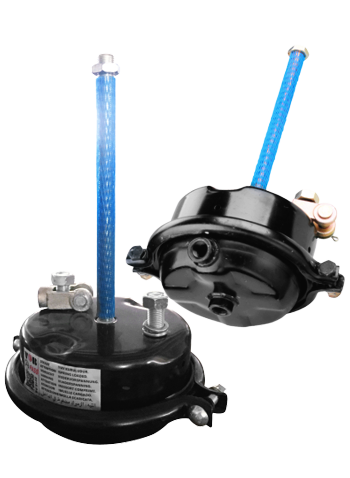 T30 Brake Chamber for Semi-Trailer Axles with In-House ManufacturingThis T30 brake chamber for semi-trailer axles comes from a manufacturer with in-house stamping, casting, and CNC machining, offering consistent quality for fleet spare-parts stocking.View Product →
Maintenance and Inspection Tips
A brake chamber needs no regular lubrication, but a few routine checks will catch trouble early.
- Look for cracks, corrosion, and air leaks around the clamp band every few weeks.
- Watch push rod stroke: it normally stays under about 2 inches on a standard chamber. If it grows suddenly, inspect the slack adjuster and shoes before blaming the chamber.
- Keep the caging bolt and dust plug installed; a missing plug lets water and salt into the spring cavity.
- Check the mounting bracket for elongated holes or cracks whenever you service the brakes.
- Compare left and right stroke readings, because a difference indicates a failing component on one side.
Frequently Asked Questions
What air pressure does a Cascadia brake chamber need?
Normal system pressure is 120 to 125 psi, but the chamber reaches full application much lower, usually by 60 to 80 psi at the port. Do not judge chamber condition by system pressure alone.
Can I replace a 30/30 spring brake chamber with a service chamber?
No. The spring side provides parking and emergency braking. Removing it leaves the drive axle with no parking brake, which will not hold the truck on a grade and does not meet commercial vehicle rules.
Are Cascadia brake chambers interchangeable with other Freightliner models?
Some chambers share the same type and stroke, but brackets, port angles, and push rod lengths differ. Match the part number or use a VIN lookup instead of assuming a chamber from another model will bolt up.
How long should a brake chamber last?
An original chamber typically lasts five to seven years in line-haul service. Road salt, leaking air lines, and high mileage shorten that, and a chamber with a torn boot or a flooded spring cavity can fail much earlier.
The pattern is simple: know the axle configuration, confirm the type and stroke before you buy, and choose a replacement made to real quality standards. When you stock spares for a Cascadia fleet, working with a supplier that covers the entire air brake system, from chambers to slack adjusters and valves, keeps the inventory consistent and the trucks moving.

 Contact Us