
 ES
 EN
 RU
 SA
A lorry that comes into the workshop with a slipping clutch is rarely suffering from one fault. More often the disc has been slipping quietly for weeks, the release bearing is dry, and a tired booster has been masking the first two. A lorry clutch is the friction coupling between the engine flywheel and the gearbox input shaft; its job is to carry full engine torque without slipping once engaged, and to break that torque briefly so the vehicle can pull away and change gear.
The short answer for a fleet fitter: if engine speed climbs faster than road speed on a gradient, if the pedal bites near the floor, or if a burning smell follows a loaded hill start, stop driving and inspect the clutch, the release mechanism and the air or hydraulic actuation together. Replacing only the disc in that situation usually produces a comeback within a few thousand kilometres.
Content
- 1 What a lorry clutch does, and why heavy-duty versions differ
- 2 How the pedal, booster and release bearing work together
- 3 Clutch components and the failures they produce
- 4 The hydraulic side: cylinders, seals and pedal feel
- 5 Symptoms that tell you which part is failing
- 6 Air supply quality decides booster life
- 7 Adjustment, free play and calibration
- 8 Choosing a replacement: the checks that prevent a comeback
- 9 Frequently asked questions
What a lorry clutch does, and why heavy-duty versions differ
A lorry clutch is a dry friction coupling that transmits the engine's full torque to the gearbox and then releases it for a moment during every start and shift.
Torque travels from the flywheel, through the driven disc and its friction lining, into the pressure plate of the cover assembly, and out through the gearbox input shaft. A diaphragm spring clamps the disc against the flywheel; when the release bearing pushes or pulls the spring fingers, that clamp load disappears and the drive is broken.
- Size and heat capacity: heavy-duty single-plate clutches commonly run discs in the 350–430 mm range, with twin-plate versions used where torque and heat load are very high.
- Release direction: many lorry clutches are pull-type, where the bearing pulls the diaphragm fingers away from the flywheel, so the bearing, fork and adjustment procedure differ from a light vehicle.
- Duty cycle: a long-haul tractor unit may shift a few hundred times a day, while a tipper on site can slip the clutch dozens of times an hour under full load.
How the pedal, booster and release bearing work together
On most heavy lorries the pedal never pushes the clutch directly; it triggers an air or hydraulic servo, which is why a heavy or dead pedal usually points at the actuation rather than the disc.
The sequence is consistent across most models:
- The driver presses the pedal, opening a control valve in the clutch booster.
- Stored air pressure (or vacuum, or hydraulic pressure on lighter chassis) acts on a piston or servo cylinder.
- The servo rod moves the release fork and cross shaft, which carries the release bearing towards the diaphragm fingers.
- The bearing releases the clamp load, the disc loses grip, and the gearbox input shaft stops turning.
Without assistance, a heavy-duty linkage can need well over 200 N of pedal effort, which is tiring in traffic and leads to poor clutch control. A healthy booster brings that down to a comfortable range and makes repeatable hill starts possible. That is also why a leaking booster seal shows up as a slow air pressure drop, a clutch that engages late, or a pedal that feels different after the vehicle has stood overnight.
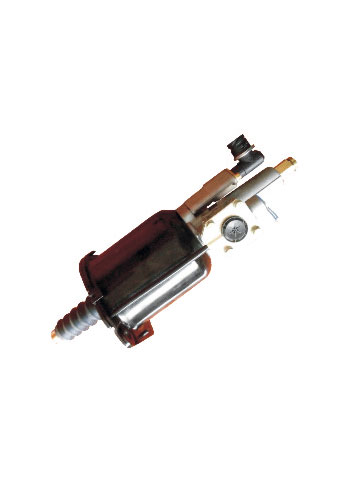 FA7012 Truck Clutch Booster for Commercial Vehicle SystemsFA7012 booster with 102 mm diameter, M16x1.5 air and M14x1.5 hydraulic connections, and 85 mm stroke; relevant when checking pedal effort or pressure loss.View Product →
Clutch components and the failures they produce
Most clutch complaints can be traced to five components, and the failure patterns below are the quickest way to narrow the list before the gearbox comes out.
| Component | Function | Typical symptom |
|---|---|---|
| Driven disc | Carries torque through its friction lining and absorbs shock via damper springs | Slip under load, judder on take-up, burning smell, worn rivets or contaminated lining |
| Cover assembly | Diaphragm spring provides clamp load against the flywheel | Reduced torque capacity, cracked or heat-checked pressure plate, broken fingers |
| Release bearing | Converts pedal or servo movement into release force | Whine or rumble with the pedal pressed, rough rotation, collapsed bearing race |
| Fork and cross shaft | Transfers servo movement to the bearing | Lost pedal travel, uneven release, squeaks, worn bushes and bent fingers |
| Booster or servo | Multiplies pedal effort using air or hydraulic pressure | Heavy pedal, slow release, air leaks, clutch drag after standing |
The hydraulic side: cylinders, seals and pedal feel
Hydraulic actuation fails from the seals outwards, so a slowly sinking pedal or a fluid level that drops without a visible puddle is an early warning rather than a minor annoyance.
A typical split system uses a master cylinder at the pedal and a slave cylinder at the release fork. Seal swell, bore scoring and contaminated fluid all reduce the stroke available to release the clutch, which produces a familiar combination: difficulty selecting first and reverse when stationary, a pedal that creeps down at a red light, and a bite point that moves as the vehicle warms up. On air-assisted models the hydraulic circuit and the air circuit are separate, and each has its own bleed or leak-test procedure.
When replacing a cylinder, check the full clutch cylinder and slave cylinder range against the bore size, pushrod length and mounting pattern on the vehicle, and inspect the fork and cross-shaft bushes at the same time. A new cylinder pushing against a worn fork will not restore a clean release.
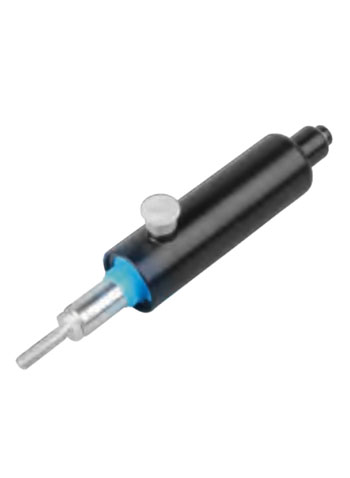 FA8787A Steel Slave Cylinder for MAN and IVECO TrucksSteel slave cylinder for MAN and IVECO applications, with listed OEM references and TS16949 certification; check bore, pushrod length and mounting pattern before replacement.View Product →
Symptoms that tell you which part is failing
Noise with the pedal pressed points at the release bearing, while noise with the pedal released and the gearbox in neutral usually comes from the gearbox itself.
Slipping under load
Engine speed rises without matching road speed on a climb. Check disc thickness, clamp load and any oil contamination from the rear main seal.
Judder on take-up
Often a glazed lining, worn engine or gearbox mounts, or a flywheel surface with heat spots. Confirm mounting condition before stripping the clutch.
Heavy or long pedal
Actuation fault: booster seal, control valve, servo rod adjustment or air pressure supply. Check system pressure at idle before condemning the clutch.
Drag and hard gear selection
Insufficient release travel, air in the hydraulic circuit, or a bearing that no longer returns cleanly on the cross shaft.
Air supply quality decides booster life
Moisture and compressor oil are the two things that shorten clutch booster life most, and both enter through the air system rather than the clutch itself.
A saturated air dryer lets water through to the booster, where it corrodes bores and hardens seals; oil carry-over from a worn compressor swells rubber components and clogs control valves. The result is a clutch that releases slowly in cold weather, drags when the vehicle has stood overnight, or needs an extra pump of the pedal. Drain the reservoirs on schedule, replace desiccant cartridges on condition rather than on hope, and treat a slow pressure drop as a system fault. The same contamination that damages a booster also reaches the brake circuit, so a healthy 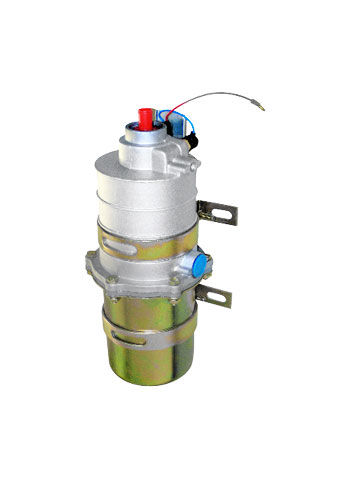 FA3004A/FA3004B 24V Air Dryer for Military and Off-Road Vehicles24V FA3004A/FA3004B air dryer with M22×1.5 or 1/2" NPT supply/delivery and M12×1.5 or 1/4" NPT control ports; suited to military and off-road vehicles.View Product → is a clutch and brake decision at the same time.
Adjustment, free play and calibration
Free play is the cheapest check on the whole vehicle and the one most often skipped, because a clutch with no free play is already slipping even if the driver has not noticed.
- Pedal free travel: commonly around 25–45 mm at the pedal pad on manually adjusted linkages.
- Bearing clearance: often 1.5–3 mm at the fork on models with an external adjustment, small enough that a worn cross shaft cannot hold it.
- Pull-type release: set the adjustment with the bearing just clear of the fingers, then recheck after a road test rather than on the ramp alone.
- Automated transmissions: the clutch is operated by an electro-pneumatic actuator, so a replacement requires a calibration or wear-adaptation routine, plus a check that the actuator stroke is within range.
Choosing a replacement: the checks that prevent a comeback
Buy on the specification, not on the part number alone, because a clutch that fits but is under-specified for the duty cycle will fail again inside the warranty period.
- Disc diameter and spline: match diameter, spline count and spline bore exactly; small differences cause rattle or premature hub wear.
- Release type and bearing: confirm pull or push operation, bearing height and the correct fork contact faces.
- Clamp load margin: allow headroom for rated gross weight plus trailer, especially for tipper and heavy haulage work.
- Kit completeness: disc, cover, release bearing and alignment tool as a set; add pilot bearing, fork bushes and bolts where worn.
- Supplier consistency: a manufacturer working to a documented quality system, with batch traceability and stable friction material, matters more than a single low quote.
| Duty cycle | Heat load | Specification priority | Service focus |
|---|---|---|---|
| Long-haul motorway | Low, steady | Efficiency, smooth engagement, long lining life | Free play, booster seals, air dryer condition |
| Urban distribution | High, frequent starts | Heat resistance, damper durability, consistent clamp load | Disc thickness, release bearing, hydraulic seals |
| Construction and tipper | Very high, partial engagement | Clamp load margin, twin-plate where specified, robust fork | Flywheel surface, fork bushes, cross shaft wear |
For fleets running mixed models, it also helps to standardise on a supplier whose commercial vehicle parts catalogue covers clutch, brake and air-system components, so one order and one quality standard covers a whole workshop visit.
Frequently asked questions
How long should a lorry clutch last?
Long-haul units often reach several hundred thousand kilometres on one clutch, while urban or construction vehicles may need attention far earlier. Driver technique and load matter more than the odometer.
Is it the clutch or the release bearing?
Press the pedal with the engine idling in neutral. Noise that appears with the pedal down is usually the release bearing; noise that disappears with the pedal down is usually inside the gearbox.
Can I drive with a slipping clutch?
Only to the nearest safe workshop, and gently. Slip generates heat quickly, and a disc that is merely worn today can score the flywheel and turn a clutch job into a flywheel job.
Do I always need to replace the flywheel?
No. Inspect for cracks, heat spots and runout; resurface or replace only when it falls outside specification. Most heavy lorry flywheels are solid and can be reused if they are within tolerance.
Why is the pedal hard after fitting a new clutch?
Usually actuation, not the clutch: a sticking control valve, a partially blocked air line, a mismatched bearing height, or a servo rod that needs readjustment.
A clutch replacement is a good moment to look beyond the bell housing. Booster seals, hydraulic cylinders, fork bushes, air dryer condition and reservoir drainage all decide whether the new disc lasts its full life or comes back on a recovery truck in a year. Measure the free play, test the air circuit, record the specification, and the next diagnosis becomes a five-minute check instead of a gearbox removal.

 Contact Us