
 ES
 EN
 RU
 SA
A truck brake system is the network of air-powered components that turns pedal input into controlled stopping force at every wheel: compressor, air dryer, reservoirs, valves, brake chambers, slack adjusters and the foundation brake itself. If you want the short answer first, most stopping faults on heavy trucks trace back either to the air supply, to a misadjusted slack adjuster, or to a leaking spring brake chamber, and that is the order worth checking them in. The sections below explain how the system works, which parts fail first, and how to compare replacements before you buy.
Content
- 1 How Truck Brake Systems Work: Stored Air, Not Hydraulic Fluid
- 2 Air Supply and Air Treatment: Where Most Faults Begin
- 3 Brake Chambers: Turning Pressure into Stopping Force
- 4 Slack Adjusters: The Cheapest Part Behind the Most Failures
- 5 Drum or Disc: Matching the Foundation Brake to the Duty Cycle
- 6 Specifying Replacement Parts: Six Details Worth Confirming
- 7 Troubleshooting: Symptom, Likely Cause, First Check
- 8 FAQ: Truck Brake Systems
How Truck Brake Systems Work: Stored Air, Not Hydraulic Fluid
Heavy trucks run on compressed air rather than hydraulic fluid for three practical reasons: air is free to replenish, it can store energy for a spring-applied parking brake, and the system fails in the safe direction, so a leak drops pressure and lets the spring brakes apply rather than releasing the service brakes.
A typical system holds 100 to 125 psi, roughly 7 to 8.5 bar, in two or more reservoirs, with the governor switching the compressor on near the low end and off near the high end.
The Service Brake Circuit, Step by Step
A brake application passes through six stages, and any one of them can produce a soft pedal or a slow release.
- Compression: the engine-driven compressor charges the wet tank, and the governor keeps pressure in range.
- Conditioning: the air dryer strips water vapour and oil before the air reaches the reservoirs.
- Storage: a four-circuit protection valve splits supply, so one failed circuit cannot empty the rest.
- Control: the foot brake valve meters pressure, and a relay valve at the rear axle draws from a local reservoir for faster response.
- Delivery: hoses, unions and quick-release valves carry air to the wheel end, while coiled lines and electrical couplers serve the trailer.
- Conversion: the brake chamber turns pressure into pushrod stroke, rotating the S-cam or pressing a disc caliper piston.
| Point of comparison | Air brake system | Hydraulic brake system |
|---|---|---|
| Typical use | Heavy trucks, trailers and buses | Light trucks, vans and passenger cars |
| Energy source | Engine-driven compressor and reservoirs | Master cylinder and brake fluid |
| Failure behaviour | Pressure loss applies the spring brakes | Fluid loss gives long pedal travel with no automatic application |
| Trailer control | Simple, through couplers and coiled lines | Complex, rarely used for heavy trailers |
| Service access | External components, individually replaceable | Lines and seals are harder to service in the field |
Air Supply and Air Treatment: Where Most Faults Begin
Air quality is the best single predictor of brake reliability, so a dryer that is overdue for a cartridge usually costs more in damaged valves than the cartridge itself.
The air dryer sits between the compressor and the first reservoir. It cools the hot, wet charge, spins out oil and water, and passes the air through a desiccant bed, after which the purge valve blows the collected moisture out on each unload cycle. In freezing conditions a heated base keeps the purge valve from icing shut, and an unloader valve stops the compressor from charging once the reservoirs are full.
 FA3004A/FA3004B 24V Air Dryer for Military and Off-Road VehiclesA 24V heat air dryer with M22×1.5 or 1/2-inch NPT supply/delivery and M12×1.5 or 1/4-inch NPT control ports for military, off-road, and personnel-carrier air systems.View Product →
What Each Valve Actually Does
Every valve has one job, and the symptom it produces when it fails is usually distinctive enough to identify before you open a toolbox.
| Valve | Primary job | Typical failure symptom |
|---|---|---|
| Foot brake valve | Meters driver-applied pressure to the service circuits | Slow pressure build-up, leak at the pedal, spongy feel |
| Relay valve | Speeds application and release at the rear axle from a local reservoir | Delayed rear braking, brakes that release slowly |
| Quick release valve | Exhausts air at the axle for a fast release | Rear brakes drag for several seconds after release |
| Four-circuit protection valve | Splits supply into separate circuits and seals off a failed one | Pressure drops on one gauge only, frequent compressor cycling |
| Unloader valve | Stops charging once system pressure is reached | Pressure creep, or a dryer that never purges |
| Levelling valve | Maintains ride height on air suspension | Suspension sags on one side, harsh ride, height faults |
Brake Chambers: Turning Pressure into Stopping Force
A brake chamber is defined by its effective area and its stroke, and matching those two numbers to the vehicle matters more than matching the bolt pattern.
The Type number on a chamber, whether 16, 20, 24 or 30, is its effective piston area in square inches, so a Type 30 chamber pushes roughly twice the force of a Type 16 at the same pressure. Long-stroke versions give the pushrod extra travel so the foundation brake stays inside its adjustment window as the linings wear down.
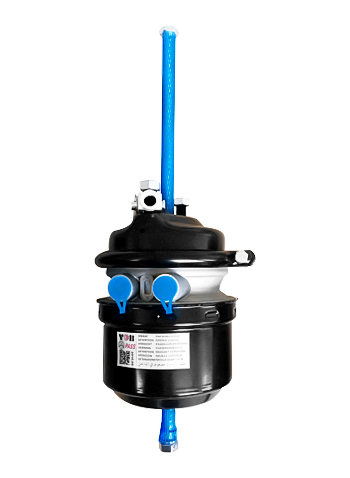 T16/24DP Air Inside Brake Chamber for Truck and Trailer BrakesAir-inside brake chamber with 57 mm stroke, M16x1.5 or M22x1.5 ports, 285 mm pushrod, and listed OEM references for commercial truck trailer brake selection.View Product →
Mounting and port details matter just as much: clamp-band or bolt-on mounting, inlet port orientation, pushrod length, clevis pin diameter, and whether the unit is a service chamber or a spring brake with a parking section. A chamber that fits the bracket but has the wrong stroke will either run out of travel before the lining is worn out, or hold the brakes partly applied.
Slack Adjusters: The Cheapest Part Behind the Most Failures
A slack adjuster is the lever that converts chamber pushrod travel into S-cam rotation, and it is the component most often responsible for a truck that pulls, drags or fails a brake performance test.
Manual adjusters need a technician to set the stroke at every service, while automatic adjusters re-set themselves during a full brake application as long as the stroke stays inside the adjustment limit. Automatic units do not remove the need for inspection; they remove the most common human error.
- Cost: manual adjusters are cheaper per piece, while automatic units cost more up front and less over a long service life.
- Setup: manual adjusters need a deliberate stroke measurement and a correct clevis setting, while automatic adjusters must be installed with a free return spring or they cannot re-adjust.
- Failure mode: manual adjusters drift out of adjustment gradually, while automatic adjusters seize or over-travel when the S-cam bushings are worn.
- Best fit: manual adjusters suit low-mileage or mixed fleets with disciplined maintenance, while automatic adjusters suit high-mileage line-haul and long-life lining programmes.
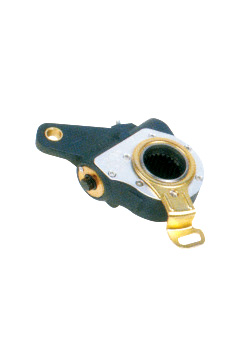 FA23001 Automatic Slack Adjuster for Mercedes-Benz Truck Brake SystemsAutomatic slack adjuster with 26 teeth, L1 115, bushing 14 and REENO 70706 reference, listed for Mercedes-Benz truck brake applications and service adjustment.View Product →
Drum or Disc: Matching the Foundation Brake to the Duty Cycle
Drum brakes still win on purchase price and on dusty vocational work, while disc brakes win on fade resistance, stopping distance at highway speed and pad-change time. A regional tipper on gravel roads is usually better served by a well-maintained S-cam drum system, while a long-haul tractor on mountain routes normally earns back air disc brakes in fade margin and lining life. Upstream of the foundation brake, the air supply, the chamber and the adjuster stay much the same either way.
Specifying Replacement Parts: Six Details Worth Confirming
Buy truck brake parts by specification rather than by photograph, because two chambers or valves that look identical can differ in ways that only appear at the wheel end.
- Type and stroke: confirm the chamber type and long-stroke marking against the original unit, not against the vehicle model alone.
- Port size and flange: common port threads and centre distances are not interchangeable, and a mismatched flange will not seal.
- Pushrod and clevis: pushrod length, thread and clevis pin diameter must match the slack adjuster you are keeping.
- Spring rating: spring brake sections are rated by spring force, and an undersized spring can fail a parking-brake hold test on a gradient.
- Quality evidence: ask for a certified quality system such as ISO/TS 16949 and a traceable batch number, especially for chambers and control valves.
Troubleshooting: Symptom, Likely Cause, First Check
Most complaints about truck brake systems fall into five patterns, and in each case the first check costs nothing.
| Symptom | Likely cause | First check |
|---|---|---|
| Pressure builds slowly | Leaking line, faulty unloader, worn compressor | Soap-test lines and couplers, then check governor cut-out |
| Brakes release slowly | Sticking quick-release valve, kinked hose, weak return spring | Watch the pushrod return after a full application |
| Uneven braking side to side | Different stroke, glazed lining, seized S-cam bushing | Compare pushrod strokes on both sides of the axle |
| Air loss overnight | Spring brake chamber, coupler seals, check valve | Charge the system, shut down and listen along the lines |
| Stroke that will not adjust | Worn slack adjuster, worn S-cam bushings, wrong chamber | Measure stroke at 60 to 80 psi and compare with the limit |
FAQ: Truck Brake Systems
How often should a truck brake system be inspected?
At every preventive maintenance service, and at least every 25,000 km or 30 days for line-haul trucks, while trailers that sit idle should have a leak test before each trip.
Can I mix manual and automatic slack adjusters on the same axle?
No. Mixing them on one axle produces a different stroke on each side, which shows up as a pull under braking and uneven lining wear, so keep both sides of an axle on the same adjustment type.
Why does my truck lose air pressure overnight?
Because air is escaping somewhere in the charged system, and the usual places are the spring brake chambers, the coupler seals and the check valves. Charge the system, shut the engine down and listen before replacing anything.
If you are buying for a fleet rather than for a single repair, standardising on one traceable part family is the simplest way to cut diagnostic time, because consistent chamber, valve and adjuster numbering means a Type 24 in one truck is the same Type 24 in the next. A supplier that covers the whole air path, from truck brake systems and air treatment through to wheel-end parts, also shortens the loop when a fault turns out to be two components rather than one.

 Contact Us