
 ES
 EN
 RU
 SA
Choose a trailer brake chamber by specification, not by photograph. Match three things — the mounting and port style, the rated stroke, and the diaphragm area the axle actually needs — and the chamber will run for years. Miss one of them and you get dragging brakes, longer stopping distances, or a spring brake that refuses to hold a loaded trailer on a grade.
A brake chamber is the part that turns air pressure into pushrod force. The slack adjuster then converts that straight push into rotation that applies the shoes or the pads. Every design detail on the chamber — its size, its stroke, the face the air enters — exists to serve that single job.
Content
- 1 What a Trailer Brake Chamber Does
- 2 Types of Trailer Brake Chambers
- 3 Reading Chamber Model Numbers: Area, Stroke and Port
- 4 Failure Signs and Inspection Points
- 5 Replacement and Buying Considerations
- 6 What to Check When You Buy by the Container
- 7 Frequently Asked Questions
- 7.1 How do I know if my trailer brake chamber is bad?
- 7.2 Can I replace a standard-stroke chamber with a long-stroke one?
- 7.3 Does air inside versus air outside change braking performance?
- 7.4 How long should a trailer brake chamber last?
- 7.5 Can I keep my chambers if I convert a trailer from drum to disc brakes?
What a Trailer Brake Chamber Does
A trailer brake chamber converts compressed air pressure into a measured pushrod force, and that force is what applies the brake.
Inside the housing, a rubber diaphragm separates a sealed air cavity from the mechanical side. When the driver presses the treadle, air at roughly 100–120 psi (7–8 bar) enters through the service port, pushes the diaphragm and the pressure plate forward, and drives the pushrod out. A return spring pulls everything back once the pressure is released. Because pushrod travel can be measured with a ruler, the chamber is also the easiest part of an air system to inspect.
On most trailer axles the chamber is a spring brake, which is really two chambers in one housing:
- The service section at the front, driven by the foot valve, performs normal braking.
- The spring section at the back holds a large coil spring under compression. Air releases it; when you pull the parking valve and the air exhausts, the spring pushes the pushrod out and the brakes stay applied.
That coil spring is stored energy. Never open the spring section of an uncaged chamber, and never treat a released parking brake as proof that the spring is safe.
Types of Trailer Brake Chambers
Three distinctions decide which chamber fits: service-only or spring brake, air inside or air outside, and drum-brake or disc-brake design.
| Chamber type | Construction | Typical use | Check before ordering |
|---|---|---|---|
| Air-inside service chamber | Single diaphragm; the service port faces the axle centre | Drum-braked axles where the hose runs from the centre outwards | Port thread, stroke class, clevis pin diameter |
| Air-outside service chamber | Same single-diaphragm design, port facing outwards | Axles with outboard hose routing or tight bracket space | The above, plus clearance to the bracket and the air line |
| Air-inside spring brake | Service section plus a spring section that applies the parking brake; port faces the axle centre | The most common chamber found on trailer axles | Caging bolt access, spring-side port, stroke class, release pressure |
| Air-outside spring brake | Spring brake with the service port facing outwards | Axles where the hose or valve sits outboard of the chamber | The above, plus the spring-side port angle |
| Disc brake chamber (including IBV-type designs) | Shorter pushrod travel, disc-specific clevis and mounting; some builds use an inverted diaphragm | Trailers with disc brakes and OEM-specific axles | Verify against the caliper bracket drawing, not the catalogue name |
Air inside or air outside: how to tell
Look at where the service port sits, not at what the carton says. Trace the hose to the chamber: if the fitting enters on the face pointing towards the axle centre or the vehicle centreline, you have an air-inside chamber; if it enters on the face pointing outwards, you have an air-outside chamber. The two are not interchangeable on the same bracket even when the stroke and area codes match.
Two further checks prevent most wrong-part returns: the clevis pin diameter and pushrod thread, and the distance from the mounting studs to the pushrod centreline. A chamber that bolts up but places the clevis at the wrong angle will hold the slack adjuster out of alignment and wear the S-cam bushings on one side of the axle.
Reading Chamber Model Numbers: Area, Stroke and Port
A chamber code normally packs three facts: the diaphragm area, the stroke class, and the port or clevis variant of that particular build.
| Code element | What it usually means | Example | Why it matters |
|---|---|---|---|
| Type number (T16, T20, T24, T30) | Effective diaphragm area in square inches; a larger area gives more pushrod force at the same air pressure | T24, T30 | An undersized chamber cannot develop the force a loaded axle needs |
| Stroke class | The rated stroke of that build, typically standard or long stroke | Standard vs long stroke | It sets the legal pushrod travel limit and how the slack adjuster is set |
| Port, offset and clevis codes (24DP, 30DD, 6200) | Inlet thread, port position or clevis configuration of that build | FA1076A-T30-30DD | The hose fitting and bracket either match or they do not, whatever the area says |
| Air inside / air outside | Which face of the chamber the service air enters | Air-inside spring brake | It decides mounting orientation and hose routing, not braking power |
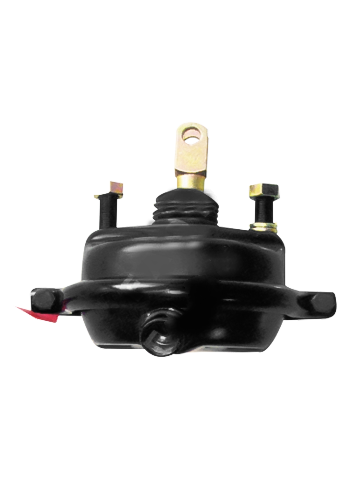 Disc Spring Brake Chambers for Heavy-Duty Trucks and TrailersCategory covers truck, bus and trailer disc spring brake chambers with many T-series models and variants for semi-trailer axles and bus applications.View Product →
Stroke limits that decide pass or fail
Applied stroke, not pedal feel, is what an inspector measures at the roadside. A clamp-type chamber with a 2 in (51 mm) rated stroke is out of service once applied stroke passes 2 in; a long-stroke chamber rated at 3 in has a 2.5 in (64 mm) limit. If the stroke is already at the limit after a correct adjustment, the wear is somewhere else — the slack adjuster, the clevis, or the S-cam bushings — and replacing the chamber alone will not fix it.
Failure Signs and Inspection Points
The first sign of a failing trailer brake chamber is usually a pushrod stroke that keeps drifting past the limit, not an obvious air leak.
- Stroke keeps growing after adjustment. The diaphragm or the return spring is tired, or the slack adjuster is slipping.
- Brakes release slowly, or the drum runs hot. A weak return spring or a restricted exhaust path, often at the valve rather than the chamber.
- Hissing at the clamp band. A pinched, perished or oil-soaked diaphragm. Oil in the air line means the compressor or dryer needs attention first.
- Cracked or deeply rusted clamp band. Replace the chamber; band failure releases stored spring energy.
- Spring brake will not hold or will not release. Broken power spring, seized caging mechanism, or moisture that has frozen inside the spring section.
A ten-minute routine catches nearly all of it:
- Chock the wheels and build system pressure to governor cut-out.
- Apply the brakes fully and measure applied stroke against the rated limit.
- Adjust or replace if the stroke is out of range; re-measure after adjusting.
- Spray soapy water on the clamp band, the service port and the fittings.
- Check the caging bolt, the manual release and the spring-side port for corrosion.
- Check the slack adjuster, clevis pin and S-cam bushings while you are under there.
Diagnose before you buy. A chamber that leaks is a chamber problem; a chamber that will not release is often a valve problem.
Replacement and Buying Considerations
Replace chambers in pairs on the same axle unless the opposite one is genuinely new, and buy by specification rather than by photograph.
- Area, stroke and type must match the axle's brake torque requirement and the existing adjustment range.
- Port thread, port offset and clevis pin must match the hose and the slack adjuster already on the trailer.
- Hardware quality matters more than paint. Band thickness, stud plating and diaphragm compound decide how the chamber behaves after two winters of road salt.
- Match the chamber to the slack adjuster. Automatic adjusters are built around a specific stroke class; a mismatch leaves the brakes permanently under- or over-adjusted.
- Treat the spring section as stored energy. Cage it before removal, and never dismantle it on the bench.
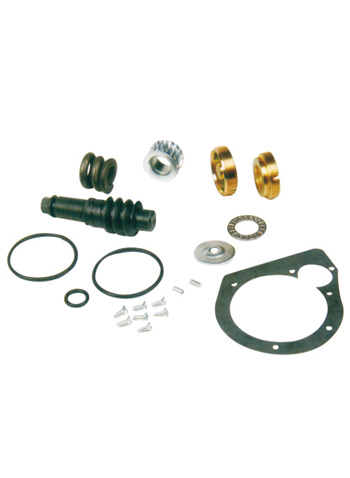 Automatic Slack Adjusters and Repair Kits for Trucks and TrailersBrowse automatic slack adjusters and repair kits for heavy-duty truck, trailer, bus and semi-trailer air brake systems, including FA23001–FA23024 models.View Product →
Buying the chamber and the adjuster from one source — for example a brake chamber and slack adjuster range built to the same stroke classes — removes one of the most common fitment errors before the parts ever reach the workshop.
What to Check When You Buy by the Container
Buy from a manufacturer that can tell you which workshop makes which part, because that is what decides consistency between shipments.
Products sold under FAQP and SHANGHAI FUAO are a useful reference point for how a supplier's answers should sound. The company behind them started in 1990 from an auto parts factory in Zhuji and now runs its own stamping, die-casting, CNC machining and assembly shops, works to the ISO/TS 16949 quality system, and exports to Asia, Europe, the Middle East and the Americas.
More practically, its part numbers behave like a system rather than a list: chambers such as FA1018A, FA1026A and FA1070A follow a fixed pattern, and the automatic slack adjuster family runs from FA23001 to FA23024, so a repeat order has one fixed identity instead of three similar-looking variants. When you audit a supplier, ask for three answers on the drawing: the applied stroke limit, the inlet port thread, and whether the chamber is air inside or air outside. A supplier who can answer all three from the drawing will usually deliver the same part twice.
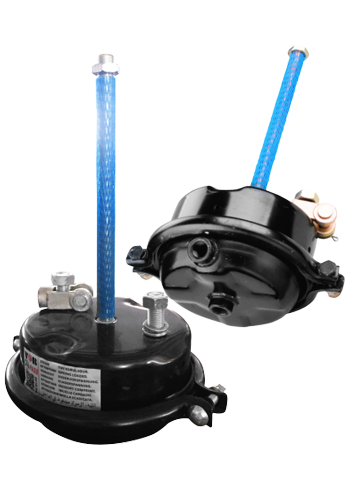 T30 Brake Chamber for Semi-Trailer AxlesT30 semi-trailer axle brake chamber in FA1002D1 and FA1002D2 variants, sharing 64 mm stroke, 285 mm push rod and different port threads.View Product →
Frequently Asked Questions
How do I know if my trailer brake chamber is bad?
Measure applied stroke at full pressure. If it exceeds the rated limit after a correct adjustment, or if soapy water shows a leak at the clamp band, the chamber is the problem. A cracked band, an oil-soaked diaphragm or a spring brake that will not hold all point the same way.
Can I replace a standard-stroke chamber with a long-stroke one?
Only as a complete change across the axle, and only if the bracket, slack adjuster and brake hardware suit the longer stroke. Mixing stroke classes left and right produces uneven braking and confuses the next technician who adjusts the brakes.
Does air inside versus air outside change braking performance?
No. Pushrod force comes from diaphragm area and air pressure. Air inside or air outside only changes which way the chamber mounts and how the hose reaches it — but getting it wrong means the chamber will not fit the bracket at all.
How long should a trailer brake chamber last?
Diaphragms are rubber, so time and environment matter as much as distance. Many fleets replace chambers at the second or third reline, or as soon as the stroke can no longer be brought back within limits. Road salt, ozone and constant heat shorten that interval noticeably.
Can I keep my chambers if I convert a trailer from drum to disc brakes?
Rarely. Disc brake chambers use shorter pushrod travel and different clevises, and the caliper bracket expects a specific mounting pattern. Treat disc conversion as a chamber change, not a chamber swap.
The short version: identify the chamber type, confirm the stroke class against the axle, check the port and the clevis, then inspect before you replace. A trailer brake chamber is a simple part, and most failures traced back to it begin with a mismatch that was invisible on the invoice.

 Contact Us