
 ES
ES EN
EN RU
RU SA
SAA Volvo VNL uses a long-stroke piggyback spring brake chamber on the drive axle and a smaller service chamber on the steer axle, and the two are never interchangeable. On a VNL with rear drum brakes, the drive-axle unit is normally a type 30/30 spring brake with a 3 in. (76 mm) nominal stroke; the front axle carries a type 20 or type 24 chamber whose pushrod length, clevis and port angle match either an S-cam slack adjuster or the lever of an air disc caliper.
A brake chamber is a clamped pair of air cylinders. The service half holds a diaphragm and a pushrod: air pressure extends the pushrod, which turns the slack adjuster and applies the brake. The spring half holds a heavy coil spring; air pressure keeps that spring compressed while you drive, and when the parking brake is set or pressure is lost, the spring applies the brake. That stored energy is why the caging bolt must be wound in fully before a spring brake chamber is unbolted.
Order the wrong stroke family, pushrod length or port thread and you get uneven braking, short lining life, or a wheel that drags after release. This guide covers how to identify the correct chamber for a VNL by axle and brake type, how long stroke and standard stroke differ, what to measure before ordering, and how to replace one safely.
Content
Which Brake Chamber Fits a Volvo VNL
Fit by axle position and brake type first, then by stroke and port layout. The model name alone will not tell you which chamber belongs on a given wheel end, because VNL tractors were built across several brake generations and two similar-looking trucks may run drum brakes on one axle and air disc brakes on another.
| Axle and brake type | Typical chamber | Stroke | Fitment points |
|---|---|---|---|
| Steer axle, drum brake | Type 20 or 24 service chamber, clamp-band mount | Standard or long | Pushrod length must suit the front S-cam slack adjuster; clevis pin and arm length must line up |
| Steer axle, air disc brake | Type 20 or 24 service chamber, short pushrod | Usually standard | Pushrod and clevis differ from the drum version; caliper lever angle sets the required rod length |
| Drive axle, drum brake | Type 30/30 long-stroke spring brake | 3 in. / 76 mm | Separate service and emergency ports, caging bolt, band bolt pattern |
| Drive axle, air disc brake | Type 24/24 or 30/30 long-stroke | 3 in. / 76 mm typical | Pushrod length is caliper-specific; release behaviour differs from a drum setup |
If your VNL runs drum brakes at the drive axle, the factory arrangement is a long-stroke type 30/30 spring brake in the T30 body size, for example the FA1076A-T30-30DD unit with a long-stroke piggyback section and caging bolt.
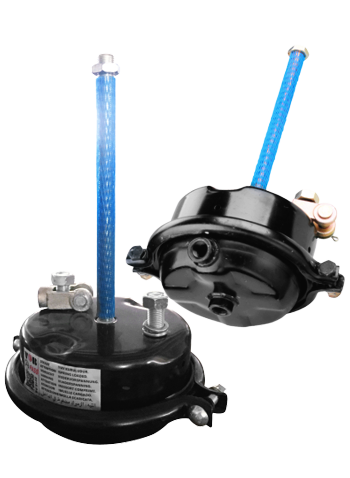 T30 Brake Chamber for Semi-Trailer Axles FA1002D1 FA1002D2T30 brake chamber with 64 mm stroke, 120.7 mm bolt centres, 285 mm pushrod, and 2-3/8 or 2-M16 ports for semi-trailer axle applications.View Product →
Long Stroke or Standard Stroke: Why the Difference Matters
One wheel end uses one stroke family: long stroke, nominally 3 in. (76 mm), or standard, nominally 2.5 in. (64 mm). Chambers, slack adjusters and pushrods are designed around one of those travel figures, and mixing them produces either an over-stroke at full application or a brake that never fully applies.
The reason is geometry. A long-stroke chamber pushes the rod further at the same air pressure, and a long-stroke automatic slack adjuster has a matching internal range. A standard chamber on a long-stroke adjuster leaves the adjuster hunting for clearance it cannot reach; the opposite pairing drives the rod past its design travel, which is exactly what a roadside inspection measures with a stroke gauge.
- Read the stroke marking on the chamber you are replacing, and order the same family.
- Never move a wheel end to long stroke without changing the slack adjuster, pushrod and, on some axles, the S-cam hardware as a matched set.
Front axles are where most mistakes happen. A type 24 steer chamber such as the FA1099B-T24-24DP looks like several other chambers in diameter, but pushrod length, clevis and port position decide whether it actually fits a VNL front axle.
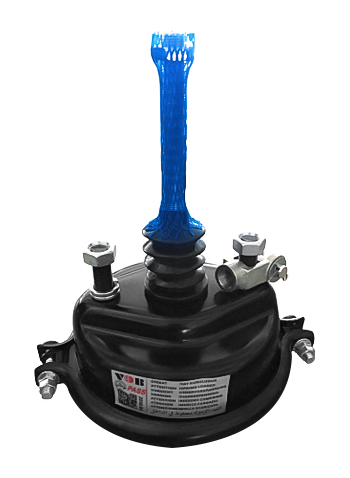 T30 Brake Chamber Variants FA1004A FA1004B and FA1004CCompare T30 brake chamber variants FA1004A, FA1004B, and FA1004C: 64 mm stroke, 120.7 mm bolt centres, 285 mm pushrod, OEM 1003519310.View Product →
Four Checks Before You Order
Record four measurements from the chamber on the truck before ordering. Any one of them wrong makes a correctly sized chamber unusable.
- Chamber type and stroke. Read the marking on the OE body: type 20, 24 or 30, plus the stroke family. This is the most reliable identifier you have.
- Pushrod and clevis. Measure rod length from the mounting face, note the clevis pin diameter, and confirm whether the chamber feeds a drum S-cam or a disc caliper lever.
- Ports. Check thread size, port angle, and whether the air line ends in a straight or 90-degree fitting.
- Mounting and caging. Confirm clamp band versus bolted flange, band bolt spacing, and that the caging bolt thread matches your caging tool.
On air disc axles, add a fifth check: disc chambers usually use a shorter pushrod than drum chambers, and a drum chamber will bolt up while leaving the caliper lever at the wrong angle. That failure is quiet, because the brakes feel fine in the yard and the wheel overheats on the first long downgrade.
What Actually Fails on a VNL Brake Chamber
Most chambers removed from a VNL are not worn out; they are contaminated or mechanically damaged, and the cause is usually upstream in the air supply or the slack adjuster.
- Swollen or hardened diaphragm, often from compressor oil carry-over or moisture reaching the chamber because air dryer desiccant is past its service life.
- Cracked or corroded clamp band, allowing the two halves to separate under spring pressure.
- Weak or broken return spring, which leaves the pushrod extended and the brake dragging.
- Corroded spring brake section, common on tractors used through salt-belt winters.
- Applied stroke beyond the adjustment limit, which usually points at a slack adjuster that has stopped adjusting rather than at the chamber itself.
Slow release has a different cause: a restricted quick release valve holds air on the chamber, so the wheel runs warm and the lining wears unevenly. Check the air circuit before condemning the chamber.
Replacing a VNL Brake Chamber Step by Step
Chamber replacement is a fast job when the safety sequence is respected and a dangerous one when it is not. Work in this order:
- Park on level ground, chock the wheels, set the parking brake, then drain the air system until the gauges read zero.
- Wind the caging bolt fully into the spring section. An uncaged spring is stored energy that releases the moment the band is cut.
- Mark the pushrod position and count the clevis threads so the new chamber starts close to the original geometry.
- Disconnect the service and emergency air lines and cap them to keep dirt out.
- Support the chamber, remove the clamp band or mounting bolts, and lift it clear; a type 30/30 spring brake is heavy.
- Transfer fittings and the caging bolt to the new chamber and check that diaphragm and spring are seated correctly.
- Install the chamber, reconnect the lines, and set pushrod length from the clevis to the slack adjuster to specification.
- Recharge the system, release the parking brake, and measure applied stroke at 90 to 100 psi. Adjust the slack adjuster only in its design direction, then road-test and re-check for drag and leaks.
Sourcing Brake Chambers and Matched Components
The useful signal when sourcing is whether the supplier controls its own metal forming and machining. Zhejiang VOB Technology, which sells under the SHANGHAI FUAO and FAQP brands, has built commercial vehicle brake parts since 1990 and runs its own stamping, die-casting, CNC machining and assembly shops under an ISO/TS 16949 quality system.
That matters for brake chambers because the first parts to fail are the least visible ones: diaphragm rubber compound, spring steel and clamp band plating. Chamber ranges are numbered in families, from FA1018A through FA1076A for the type 20, 24 and 30 bodies, with suffixes recording stroke and port configuration such as T24-24DP, so a replacement can be traced back to a specification rather than guessed from a photo. The full brake chamber range is listed by category and model, alongside matching slack adjusters, relay valves, quick release valves and air dryers.
Pair a new chamber with a matched automatic slack adjuster, such as the FA23001 series, whenever the old adjuster is seized or was set up for a different stroke, and inspect the air dryer at the same time.
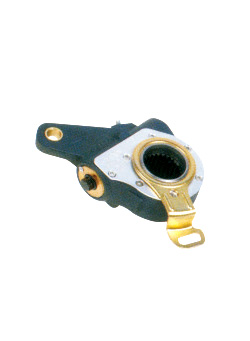 FA23001 Automatic Slack Adjuster for Mercedes-Benz Truck BrakesMercedes-Benz auto slack adjuster, reference 70706, with 26 teeth, L1 115 and bushing 14; pair with matching chamber when replacing seized units.View Product →
Frequently Asked Questions
Can the same brake chamber be used on both the steer and drive axles of a VNL?
No. The drive axle needs a spring brake chamber because it must hold the truck when air pressure is lost, while the steer axle uses a service-only chamber. Even where body size looks similar, ports, pushrod and mounting differ.
How often should VNL brake chambers be replaced?
Replace on condition, not on a fixed interval. At every brake service, check for a swollen or oily diaphragm, a cracked band, a weak return spring and stroke beyond the adjustment limit. A chamber that passes those checks does not need replacing because of age alone.
Do I have to replace the slack adjuster when fitting a new chamber?
Not automatically, but the two must agree on stroke family and travel. If the adjuster is seized, has a worn clevis, or was set up for another stroke type, replace it with the chamber. A new chamber running on a tired adjuster will run out of stroke within months.
Will a long-stroke chamber make my VNL stop better?
No. Stroke type is a system design choice, not a performance upgrade. Long-stroke chambers fitted without the matching slack adjuster and pushrod geometry cause over-stroking, uneven braking and a truck that fails a brake inspection.
The short version: match the chamber to the axle and brake type on your VNL, keep both halves of a wheel end in one stroke family, verify pushrod length and ports before ordering, and treat oil and moisture in the air supply as the root cause of most chamber failures.

 Contact Us