
 ES
ES EN
EN RU
RU SA
SAA slack adjuster is the lever that links the brake chamber pushrod to the S-cam shaft on an air-braked truck, trailer or bus, and it keeps brake stroke within its limit as the friction material wears. In plain terms, it turns the straight push of the brake chamber into the rotation that spreads the brake shoes, and it takes up the slack, meaning the running clearance between lining and drum, so the brakes keep applying with a short, repeatable stroke.
That definition explains the stakes. Once the adjuster stops taking up clearance, pushrod travel grows, the chamber runs out of usable stroke, braking force falls away and the drums run hot. Over-stroke is an out-of-service defect at a roadside inspection. The adjuster is a wear-compensating device, not a fixed bracket, and that is the part of the answer most people miss.
Content
- 1 Where the Slack Adjuster Sits in the Air Brake System
- 2 Manual and Automatic Slack Adjusters Do the Same Job Differently
- 3 Brake Stroke Is the Number That Proves the Adjuster Is Working
- 4 How to Identify the Right Slack Adjuster Before You Order
- 5 Adjusting and Inspecting: What to Do and What to Avoid
- 6 Failure Signs That Justify Replacing the Unit
- 7 Frequently Asked Questions
Where the Slack Adjuster Sits in the Air Brake System
It is the only pivot between the air side and the friction side of the brake: everything upstream supplies air, everything downstream creates friction.
- The compressor builds air; the dryer and reservoirs store it.
- The foot valve signals a relay or quick-release valve, which sends air to the brake chamber.
- The chamber converts air pressure into a linear push of the pushrod, typically 2 in (51 mm) or less at full application.
- That pushrod is pinned, through a clevis, to the arm of the slack adjuster.
- The adjuster is splined to the S-cam shaft and rotates it, spreading the shoes against the drum.
Two geometry facts follow from that chain. Arm length sets the leverage, and a longer arm delivers more torque to the S-cam for the same chamber force, so it has to match the vehicle rather than be chosen for convenience. And because the adjuster is splined to the S-cam shaft, spline count, shaft diameter, rotation direction and offset must all line up before the unit will even mount.
Manual and Automatic Slack Adjusters Do the Same Job Differently
Both types compensate for lining wear; the difference is who does the compensating, a technician with a wrench or a mechanism inside the housing.
| Point of comparison | Manual slack adjuster | Automatic slack adjuster |
|---|---|---|
| Wear compensation | A technician turns the adjusting hex during service | An internal clutch senses over-stroke and takes up clearance during a brake application |
| Routine adjustment | Expected; stroke is measured and reset at every maintenance visit | Not expected; a healthy unit holds its setting for the life of the lining |
| Main risk | Over-tightening causes drag and heat; neglect causes long stroke | Repeated hand adjustment wears the internal clutch and hides the real fault |
| Where it fits best | Older equipment and fleets with disciplined inspection routines | Modern tractors, trailers and long-haul fleets |
Fleets that treat automatic units like manual ones usually pay for it. Regularly hand-adjusting an automatic slack adjuster loads parts that were designed to move only through the internal mechanism, and it shortens the service life of the unit.
For manual systems, our own range runs as a continuous FA9001 to FA9036 series in left- and right-hand versions, with straight and offset arms:
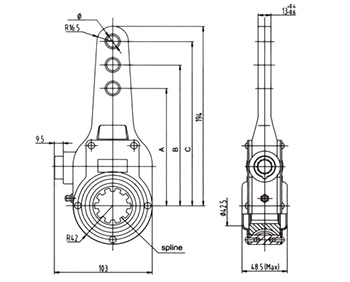 Manual Slack Adjuster for Truck Brake SystemsManual slack adjuster for manual brake systems, with the related range covering FA9001-FA9036 left/right and straight/offset arm versions.View Product →
For automatic replacement, the FA23001 to FA23024 series covers the arm lengths and splines used on current tractor and trailer axles:
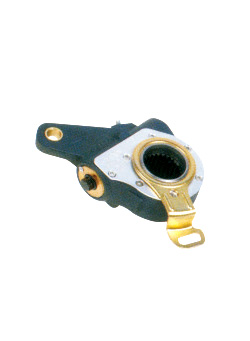 FA23001 Auto Slack Adjuster for Mercedes-Benz Truck BrakesAutomatic slack adjuster, FA23001/REENO 70706, for Mercedes-Benz vehicles with 26 teeth, L1 115, bushing 14; part of FA23001-FA23024 series.View Product →
Brake Stroke Is the Number That Proves the Adjuster Is Working
If applied stroke stays inside the limit published for the chamber, the adjuster is doing its job; if it does not, the brake is out of adjustment no matter how clean the unit looks. The check takes minutes: build system pressure to 90-100 psi, mark the pushrod at the chamber face, apply the brake fully, then measure how far the mark travels.
| Chamber type | Stroke design | Typical maximum applied stroke |
|---|---|---|
| Type 30/30 | Standard | 2 in (51 mm) |
| Type 30/30 | Long stroke | 2.5 in (64 mm) |
| Type 16 to 24 | Standard | 1.75 in (44 mm) |
Measure with the brake applied and the engine off. Both sides of an axle should read within roughly 1/8 in (3 mm) of each other; a large split usually points to one adjuster, one chamber or one set of S-cam bushings rather than to the whole axle. A stroke that creeps back over the limit within a few thousand kilometres is the clearest sign that the adjuster has stopped holding.
How to Identify the Right Slack Adjuster Before You Order
Five specifications decide whether the part fits: spline count and shaft diameter, arm length, rotation direction, offset, and adjustment type. Get any one of them wrong and the unit either will not mount or will not hold stroke.
| Specification | How to read it | What goes wrong if it is wrong |
|---|---|---|
| Spline count and shaft diameter | Count the teeth on the S-cam shaft and measure its diameter | The unit will not slide onto the shaft |
| Arm length | Measure from the centre of the S-cam bore to the centre of the clevis pin hole | Wrong leverage and wrong stroke geometry |
| Rotation direction | Note whether the arm points forward or rearward and which side of the axle it serves | The adjuster works against the linkage instead of with it |
| Offset | Check whether the arm is straight or offset relative to the bore | Clevis and chamber bracket interference |
| Adjustment type | Confirm manual or automatic, and the position of the adjusting hex | Poor access in service and the wrong maintenance routine |
Where possible, read the stamped number from the old unit and cross-reference the full specification instead of matching on arm length alone. Many catalogue errors start with an adjuster that looked identical but carried a different spline or offset.
Adjusting and Inspecting: What to Do and What to Avoid
Measure stroke first, adjust only when the measurement calls for it, and never treat an automatic unit as if it were manual.
- Chock the wheels, release the parking brake and cage the spring brake according to the manufacturer's procedure before touching the linkage.
- On a manual adjuster, turn the adjusting hex until the lining contacts the drum, then back it off until the wheel turns freely, usually a quarter to half a turn.
- On an automatic adjuster, use the manual override once to bring a badly out-of-adjustment brake back into range, then apply and release several times and re-measure.
- If the stroke drifts out again shortly afterwards, replace the unit; a slipping internal clutch cannot be repaired in service.
- Keep the boot intact and the splines lightly protected, but never pack grease into the adjusting mechanism, where it will collect grit.
- Inspect the clevis pin, cotter pin and S-cam bushings at the same time, because worn bushings imitate adjuster failure and will destroy a new unit in the same way.
Failure Signs That Justify Replacing the Unit
Slack adjusters rarely fail without warning; stroke growth, heat and looseness are the usual early clues.
- Applied stroke over the chamber limit, and on one side of an axle only.
- An adjusting hex that turns without changing stroke, or a setting that will not hold.
- A torn boot with rust-coloured weeping, or heavy corrosion on the worm gear.
- Elongated clevis pin holes, missing cotter pins or a loose arm on the splines.
- Hot drums, a burning smell after a short run, or linings worn at the leading edge only.
Worn S-cam bushings, a bent pushrod or a chamber that no longer returns can produce the same symptoms, so check those before blaming the adjuster, and check the chamber itself if the pushrod is scored or the clamp band is distorted:
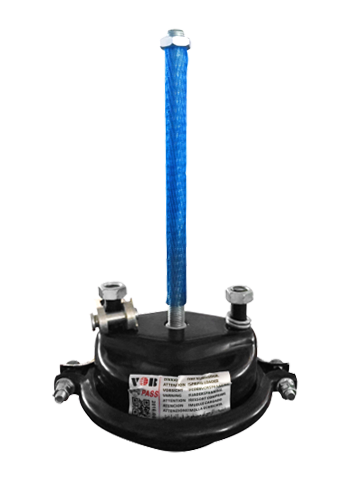 T24 Brake Chamber for Bus Trailers and Commercial VehiclesT24 brake chamber with FA1007A/B/C variants, 64 mm stroke, 120.7 bolt centre and 285 mm push rod, differing by port, bolt and push rod threads.View Product →
Frequently Asked Questions
Is a slack adjuster the same thing as a brake chamber?
No. The chamber turns air pressure into a linear push, while the slack adjuster turns that push into rotation and compensates for lining wear. They share a bracket but do different jobs.
Do automatic slack adjusters need manual adjustment?
Only to reset a brake that has fallen badly out of adjustment. Routine hand adjustment of a healthy automatic unit accelerates internal wear and conceals the underlying fault.
How often should slack adjusters be checked?
Stroke belongs in every pre-trip inspection and should be measured properly at every preventive maintenance service. Automatic units are adjustment-free when healthy, not maintenance-free.
Does a longer arm give stronger brakes?
A longer arm raises the torque applied to the S-cam for the same chamber force, but leverage is designed into the vehicle. Fitting a longer arm to gain braking power disrupts stroke and brake balance and should not be done.
In short, a slack adjuster is the wear-compensating lever that keeps an air brake's stroke short enough to stop the vehicle, and its condition shows up in one measurement: applied pushrod stroke. Match spline, arm length, rotation and offset when you replace one, adjust manual units on schedule, leave automatic units alone unless the stroke says otherwise, and the brake system stays inside its limits. If you are renewing chambers, valves or fittings at the same time, the full SHANGHAI FUAO brake system range covers the components that work with this linkage.

 Contact Us